
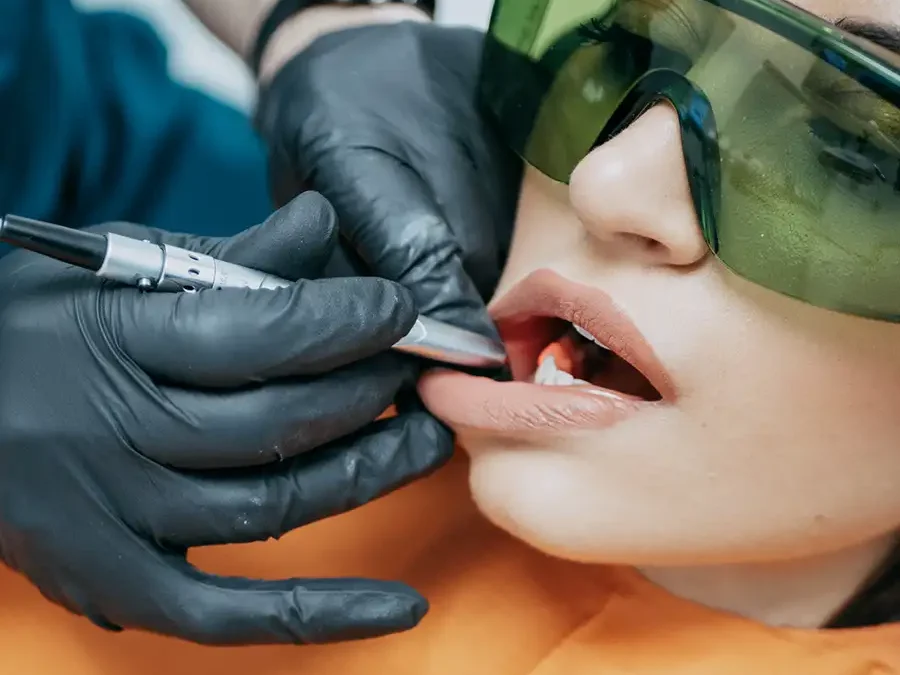
Teeth whitening is one of the most popular aesthetic treatments, but also one of the most underrated. It is often perceived as a simple and risk-free procedure, when in fact it is a medical treatment that must be carefully evaluated and managed.
In this article I want to clearly explain how tooth whitening works, what are the real benefits, but also risks, limitations and contraindications, to help you understand if it is the right treatment for you.
What is tooth whitening and how it works
Teeth whitening is an aesthetic dental treatment that aims to lighten the colour of natural teeth by acting on the pigmentations that are deposited on the surface of the enamel and in the dentine every day. In fact, it is a controlled chemical reaction releasing active oxygen capable of disrupting the molecules responsible for dyschromia. Hydrogen peroxide or carbamide peroxide are the safest and most widely used active ingredients.
The result depends on several factors:
- the whitening protocol chosen by the dentist or dental hygienist,
- the starting colour of the teeth and the desired objective,
- the clinical assessment of the cause of the tooth colour alteration (genetic alteration or loss of brightness and whiteness of natural teeth due to extrinsic pigmentations),
- the quantity and quality of the starting enamel (the more enamel, the better the result of tooth whitening)
- lifestyle (diet, smoking, coffee or herbal tea abuse),
- effective home plaque control
- the individual tooth response.
This is why not all teeth whiten in the same way and that an initial clinical evaluation is always essential.
Teeth whitening: risks, contraindications and side effects
If performed without a proper clinical indication and with a protocol that is not suitable for your smile, bleaching can cause annoying side effects or unsatisfactory results. The most common are transient tooth sensitivity and gingival irritation, especially when treatment is not adequately controlled.
There are also real contraindications, such as untreated caries, gingivitis or unrealistic aesthetic expectations. In these cases, proceeding without a diagnosis means exposing oneself to unnecessary risks or disappointment about the final result. In cases of hypersensitivity (a symptom that should not be underestimated and which requires the right clinical investigation), first this condition is treated, e.g. with customised protocols home remineralisation with products based on Amorphous Calcium Phosphate (ACP), and then proceed with a customised tooth whitening protocol.
Benefits of professional tooth whitening at the dentist
A whitening performed or planned by a dentist makes it possible to achieve predictable and safe results.
The main advantage is the clinical control of the entire process: the first dental visit, during which the general medical history is carefully assessed, is fundamental.
Next, a careful clinical examination of the patient's teeth is performed and hygiene and nutritional habits are assessed with him. Only at the end is the most suitable whitening protocol to his smile and his needs.
Another fundamental aspect is the’aesthetic harmony. The final colour should not be “as white as possible”, but consistent with the person's face, age and smile. This is what makes the result natural and credible over time.
LIP WHITENING AND LIP FILLERS: COMBINED TREATMENTS TO ENHANCE THE SMILE
Home bleaching: differences with in-office treatment
Home bleaching is an effective and safe solution when it is prescribed and controlled by the dentist. In my approach it is never a standard treatment, but a customised pathway, built around the patient's clinical condition and needs.
When I propose a home whitening, I always start with an accurate assessment of teeth and gums. If caries, inflammation, major hypersensitivity, dental crowns on implants or natural teeth are present, I prefer to intervene on these aspects first, because theor bleaching works correctly only on healthy, natural teeth (it is not possible to bleach crowns made of Ceramics, Zirconia, Lithium Disilicate).
I then design and make making customised masks from my workshop, designed to adapt precisely to the teeth. This allows the whitening gel to act evenly, reducing the risk of gum irritation and improving treatment comfort. I personally define the concentration and time of use, explaining to the patient how to apply the product and how to manage the treatment at home correctly.
The result is progressive and controlled and my patients are happy because they tell me that every morning they look in the mirror and see their teeth whiter - it's very nice!
How long does whitening last and how to keep teeth white over time
Teeth whitening is not permanent, but it can last for a long time if it is part of a proper course of prevention. The duration can go up to 4 years for all attentive patients who follow my home post-treatment instructions.
To keep teeth white over time, it is essential to combine whitening with professional hygiene sessions with customised periodic intervals, proper home hygiene and lifestyle (abuse of coffee, herbal teas and smoking is not recommended) and, when necessary, targeted recalls.
The goal is not to chase an artificial white, but to preserve a bright and healthy smile over time.
DISCOVER OUR TEETH WHITENING TREATMENTS
Teeth whitening in Milan: the City Life Institute approach
At City Life Institute, tooth whitening is part of a customised clinical pathway.
Each patient is carefully assessed to choose the most suitable protocol between in-office, home or combined treatment. Our approach is based on diagnosis, control and gradualness, with the aim of achieving a natural, safe and stable aesthetic result.

Author: Dr. Valentina Zurlo
Do you want to find out if tooth whitening is right for your smile?
Book a consultation at City Life Institute: together we will assess the best solution for your case, with clarity and without unnecessary treatment.