
City Life Institute
Computer-guided implantology
Restoration of missing teeth and correct mastication
City Life Institute
Dental implants with minimally invasive technique in Milan
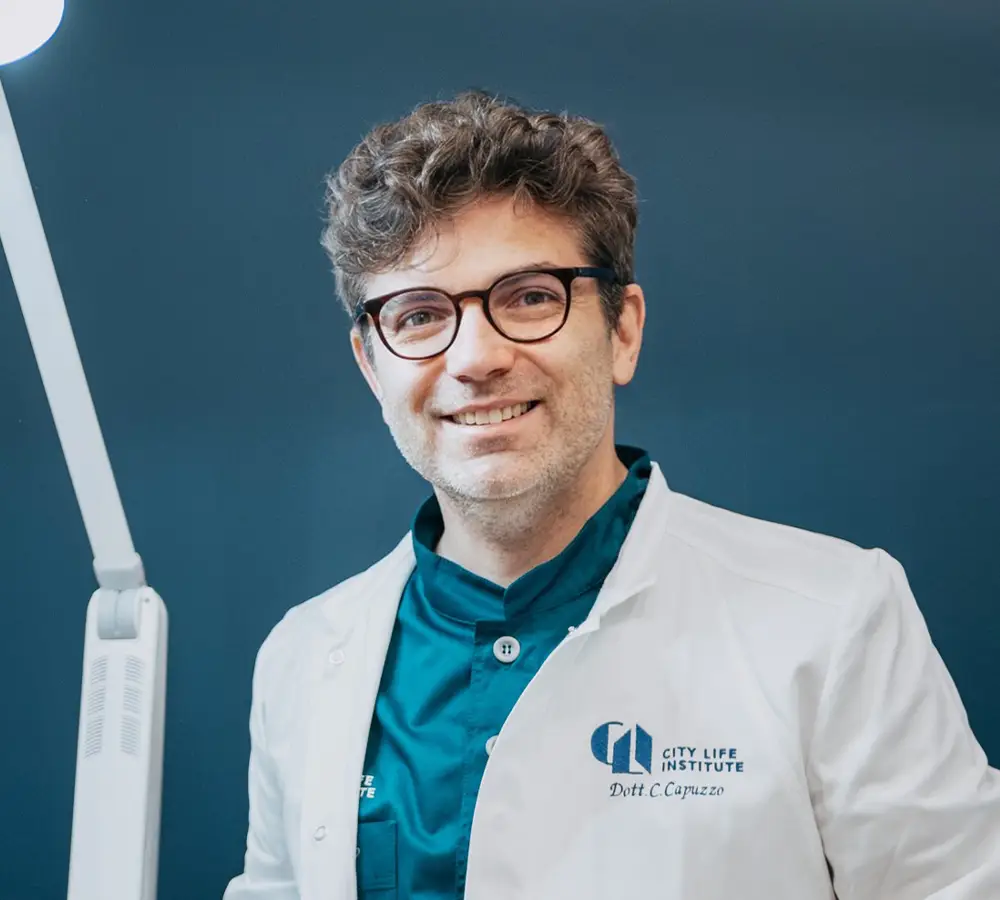
Implantology is one of the elective disciplines of City Life Institute. With the help of modern software 3D design,implant surgeries are simulated by the surgeons on the PC, determining the most precise and functional position of the dental implants beforehand. Thanks to the study and 3D programming, the surgery that will be performed will be more precise and minimally invasive, fast and, consequently, with a faster and more painless post-operative course.
Digital design
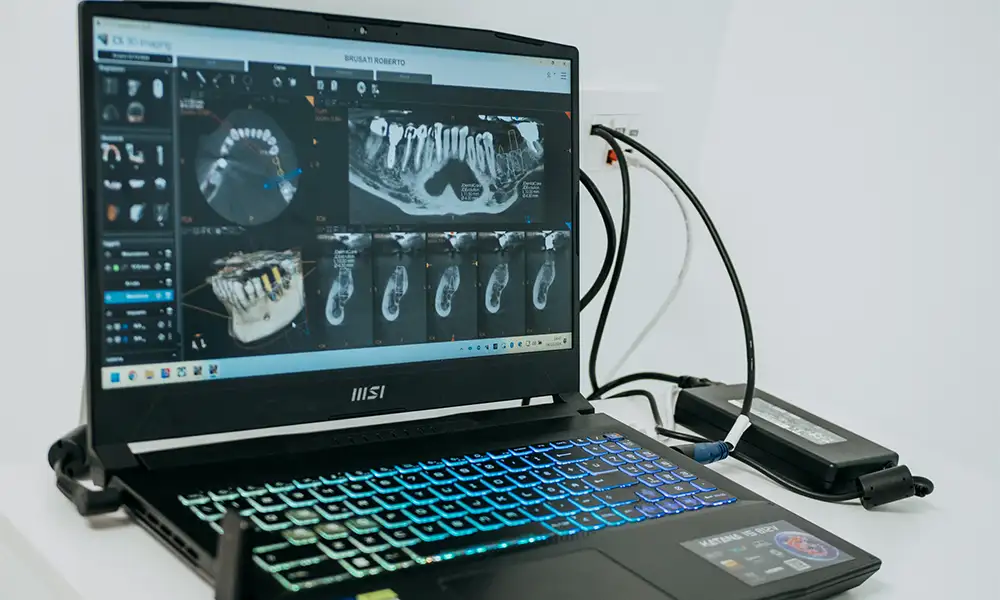
The guided surgery software allows surgeons to process images of teeth, bones and arches, produced by the Cone Beam CT, to plan the intervention in every detail.
La simulation on a virtual model helps establish the correct position of implants by drawing sections of the bone model and calculating their density. This reduces chair time and the invasiveness of the procedure.
The flapless technique
Thanks to the design phase, once the types of implants to be inserted and the exact portions to be operated on have been established, a special template with calibrated holes can be made (surgical template).
This allows place the implants in the precise location established, without gum incisions. Stitches are thus avoided and post-operative recovery is faster.
City Life Institute
Fear of the dentist?
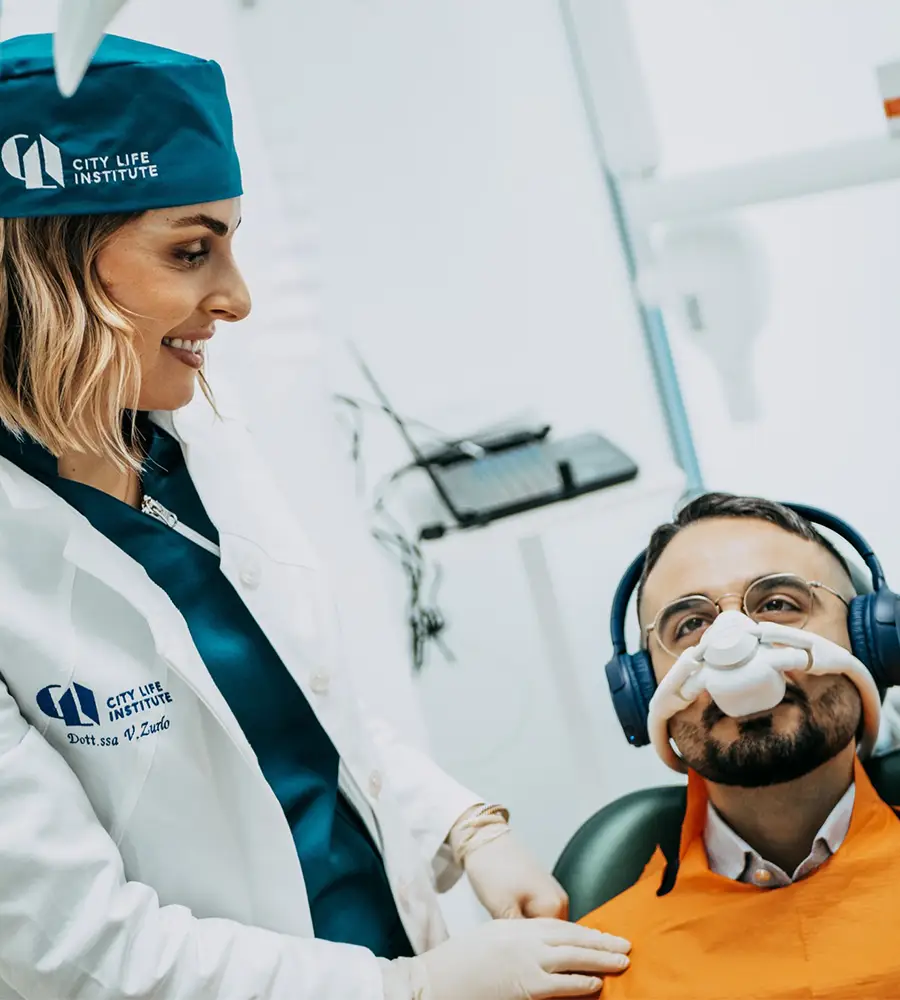
We have inhalation conscious sedation
If the dentist's session creates anxiety and agitation in the patient, we can resort to inhalation conscious sedation: quick, non-invasive and suitable for all ages, it guarantees total relaxation in a few minutes while remaining alert at all times.
Implant surgeries performed at City Life Institute
Dental implants immediate load
Among the many advantages of digital design is the possibility of making provisional prostheses before the operation. This allows patients to ensure a’immediate aesthetic-functional rehabilitation.
When bone volumes are such that rapid osseointegration is possible, we can also perform so-called immediate loading: a technique that allows chewing to be resumed within 48 hours after surgery.
Dental implants deferred load
When a patient has such a bone deficit that the implant cannot be accommodated, we proceed with regeneration surgery and rely on deferred loading.
This means that, by waiting the necessary time, both for bone regeneration and for proper osseointegration of the implant, it will be possible to place the definitive prostheses after about 3/6 months.
Dental implants post-extractives
A careful evaluation of a 3D-CBCT scan performed in the practice can select cases in which so-called ‘’post-extraction’’ dental implants are placed at the same time as extraction.
In selected cases, ‘immediate post-extraction loading’ can also be applied immediately after removing one or more teeth.
When this is possible, thanks to advanced implant surgery, We rehabilitate patients in a single session, by fixing the temporary teeth - made earlier - in a stable manner at the same time as the extraction.
To design unique smiles we use the Digital Smile Design
so our patients know immediately what the final result will be
Surgery in the absence of jawbone
When one spends many years without natural teeth in the mouth, it happens that the jawbone recedes.
In the presence of bone deficits that do not allow osseointegration of implants, surgery can be used to restore the optimal condition. There are two practicable techniques and they are chosen by the doctor according to the site concerned and the patient's general health.
Guided bone regeneration
The surgery serves to recover, horizontally or vertically, the lost bone volume. The volume increases involve the grafting of bone tissue autologous (taken from the same patient), or heterologous (with synthetic or animal membranes).
Sinus lift
Intervention serves to recover the quantity of bone required to implant engagement in the molar area of the upper arch. It is useful when the molar or premolar part is affected by a shortage of bone in the vertical direction. The technique involves elevating the maxillary floor so that there is more bone volume to work with.
City Life Institute
Dental & Aesthetic Medicine