
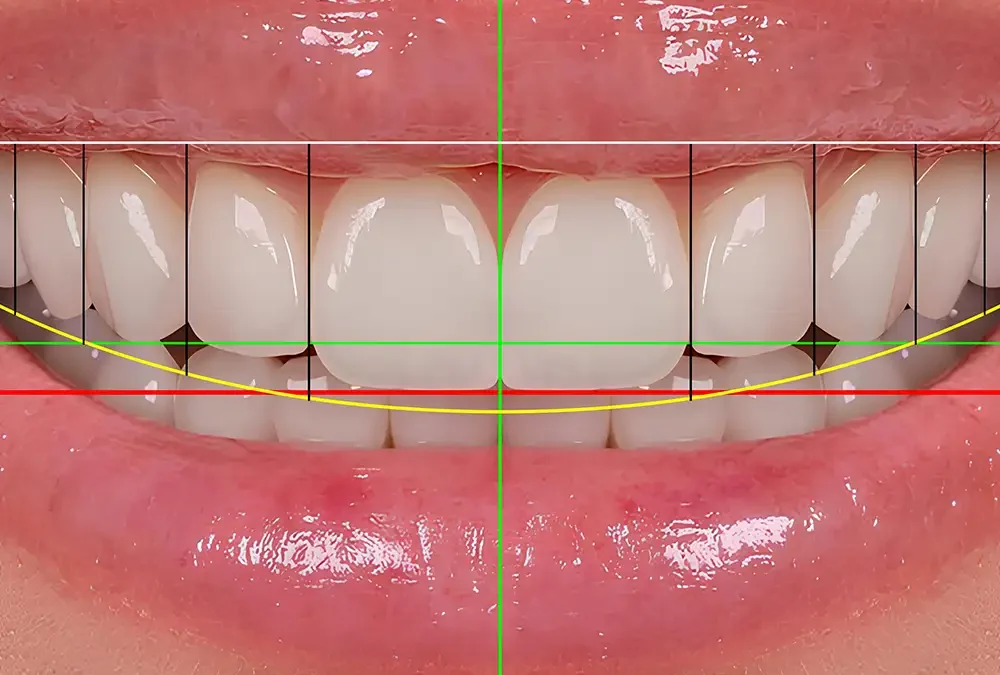
When a patient tells me about their desire to improving one's smile, I know he is not just talking about teeth. He is talking about how he sees himself, how he feels, how he relates to others. That is why, in my approach to dental aesthetics, design is as fundamental a phase as the actual treatment.
The Digital Smile Design (DSD) was created with precisely this objective: to transform an often vague or emotional idea into a clear, shared and measurable project. In this article, let's see together what it is and what benefits it brings to modern aesthetic dentistry.
What is Digital Smile Design
DSD is a digital protocol which uses photographs, videos, facial scanners and dedicated software to thoroughly analyse the relationship between smile, lips and face. It does not just “design beautiful teeth”, but studies proportions, symmetries and balances, allowing a preview of the final result before starting any treatment.
From the imagined smile to the planned smile
One of the aspects that patients appreciate most about Digital Smile Design is the possibility of seeing one's future smile. This completely changes the healing experience.
It is no longer a question of relying on abstract descriptions or generic examples, but of observing a simulation built on one's facial features, on one's expressions and on one's way of smiling.
This design phase becomes a real moment of dialogue. The patient can understand the aesthetic choices, express preferences, ask questions and feel an active part of the process. From a clinical point of view, this allows us dentists to planning the treatment more precisely, reduce unforeseen events and increase the quality of the final result.
Applications of Digital Smile Design in Aesthetic Dentistry
One of the aspects that makes the Digital Smile Design such a valuable tool is its versatility.
This is not a technology designed for a single treatment, but a true design method that accompanies different areas of aesthetic dentistry.
In my daily work, I use DSD whenever it is necessary to visualise, plan and share a smile change in a way that is conscious, predictable and respectful of the balance of the face. Each application has specific goals, but they all start from the same principle: plan before you act.
Veneers and crowns: customised and minimally invasive aesthetics
In the field of prosthetics, Digital Smile Design represents a fundamental step to obtain results that are natural and consistent with the face of the patient. Through digital design I can precisely study the shape, size and proportions of teeth, assessing the aesthetic impact not only with the mouth open, but also during smiling, speech and spontaneous expressions.
Thanks to digital simulation, I assess in advance how much to intervene on the natural tooth, avoiding excessive preparations and preserving as much healthy tissue as possible. This approach not only improves the aesthetic result, but also contributes to maintaining dental health over time, making the treatment more sustainable and long-lasting.
Aesthetic orthodontics: predictability and path awareness
Digital Smile Design also finds application in aesthetic orthodontics, particularly in transparent aligner treatments. In these cases, the possibility of visualise the final result before starting treatment is of great help to the patient.
It is no longer just about “straightening teeth”, but about understanding how the smile will change as a whole, in terms of harmony, proportions and relationship to the face. For adults, this predictability is particularly important: knowing in advance how the smile will evolve increases motivation and encourages greater adherence to treatment, making the experience more serene and conscious.
Aesthetic and functional rehabilitation: rethinking the smile as a whole
In cases where teeth are worn, damaged, misaligned or compromised by old restorations, Digital Smile Design becomes a central tool in aesthetic and functional rehabilitations.
In these situations, one does not work on the individual tooth element, but on the’overall balance of the smile, mastication and occlusion.
Digital design allows precise coordination of the different treatment steps, facilitating dialogue between clinician and laboratory and reducing margins of error. The result is a more harmonious, stable and functional rehabilitation, designed to last and integrate naturally with the patient's face.
Gingival smile and surgery: more confidence, less uncertainty
Digital Smile Design is also particularly useful in managing the gingival smile and planning oral surgery and implantology.
Being able to simulate the outcome of a gingival correction or implant rehabilitation helps the patient to approach the treatment with greater peace of mind, reducing anxiety related to the uncertainty of the outcome.
From a clinical perspective, this simulation phase improves the accuracy and predictability of the intervention, allowing for more accurate planning and a safer and more controlled course of treatment.
Dental aesthetics in Milan: the City Life Institute approach
In City Life Institute, dental aesthetics is part of a integrated approach which combines clinical expertise, advanced technology and a genuine focus on the individual. For this reason, digital design utilises state-of-the-art technology such as the intraoral scanner and facial scanner, which provide a complete view of the smile within the face. With us, every treatment is planned with respect for oral health, prioritising conservative and natural solutions, because we believe that dental aesthetics should never be divorced from function, nor from the relationship of trust between doctor and patient. It is from this vision that an authentic, balanced and truly personal smile is born.
Information note: This article is for informational purposes and does not replace a direct clinical evaluation. Indications, frequency of check-ups and treatment methods must be determined by a doctor on a case-by-case basis.
Dentist and Aesthetic Doctor, Postgraduate in Implantology, Oral Rehabilitation NYU, Master in Oral Surgery and Implantology UNIBO, European Master in Aesthetic Medicine ICAMP – Milan, Order of Physicians Milan Dental Practitioners Register 5921, Register of Medicine with an Aesthetic focus